
Meeting the Need
/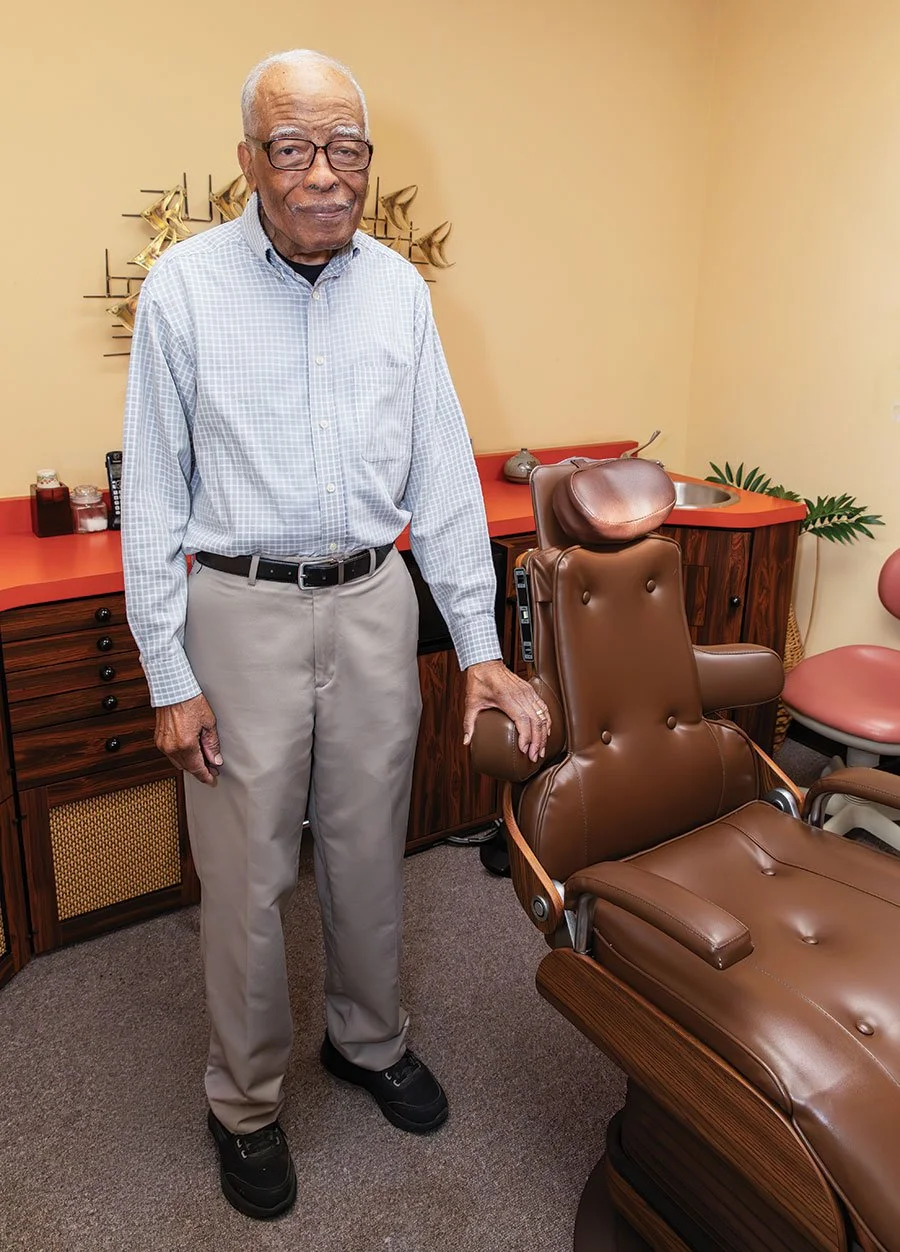
Photo by shane darby
Dr. Denzer Burke, 93, has served Texarkana as a dentist and civic leader for over 60 years
By Jaime Knighton
Respected, community-minded, and deeply accomplished are only a few of the words used to describe Dr. Denzer Burke. Over the course of his 93 years, the dentist and civic servant has made countless contributions to the Texarkana community. Recently featured in the Texas Dental Journal for several decades of membership with the Texas Dental Association, Denzer will celebrate 64 years with the organization this August. However, dentistry represents only one chapter in a long life shaped by military service, civic leadership, faith, and advocacy.
Early Life
Born in Atlanta, Georgia, Denzer and his family moved to Michigan when his father returned from World War II, in which he served as an army cook in both Belgium and France. “When he came back, conditions in the South were difficult, so we moved to Michigan where we had family,” Denzer said.
Growing up, he was heavily involved in school activities. Denzer was a member of the school newspaper staff, sang in the a cappella choir, and participated in academic competitions. “I always wanted my name in the paper for getting good grades,” he laughed. “My classmates and I competed with each other to see who could get the most A’s and receive recognition in the community newspaper.”
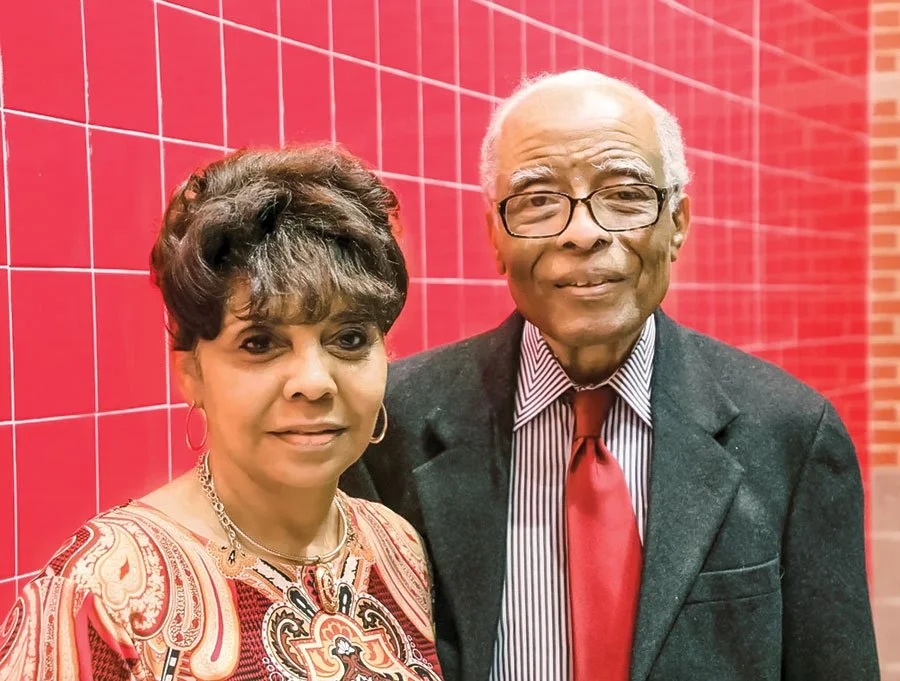
Ann and Denzer have been married for 51 years. submitted photo
Education and Military Service
After he finished high school, Denzer earned his bachelor’s degree at the University of Michigan before being admitted to the Howard University College of Dentistry. By the end of his second year of dental school, he had become a commissioned dental officer in the U.S. Naval Reserve. “At that time, there were almost no Black officers in the Navy,” he said. “They were recruiting, and I liked the uniform, so I joined.”
Dr. Burke spent three years stationed at a naval dental clinic in Brooklyn, New York. At one point, he received orders to serve aboard an icebreaker headed to the South Pole. However, just before deployment, the orders were reassigned to another officer, much to his relief. Later, while serving aboard the USS Sierra AD-18 in Norfolk, Virginia, his voyage delivered medical supplies to Port-au-Prince, Haiti, and took him to Guantanamo Bay, Cuba. Upon return to the states, Dr. Burke became a witness to preparations surrounding the Cuban Missile Crisis.
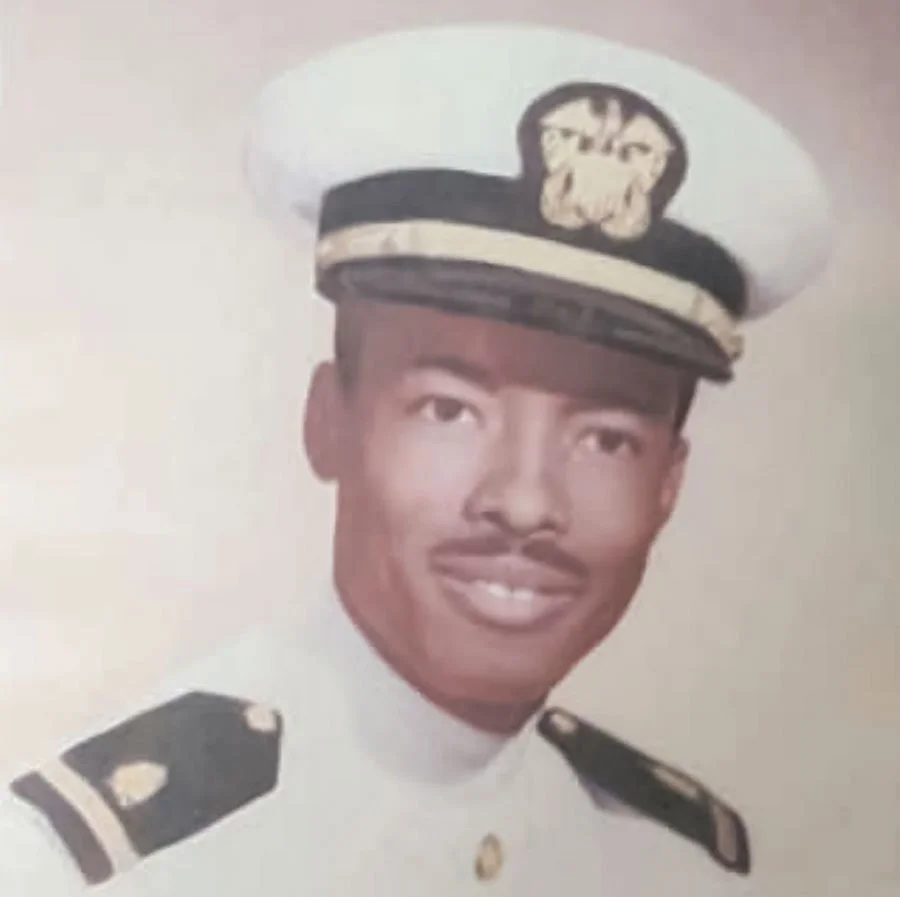
Dr. Denzer Burke served as a dental officer in the U.S. Naval Reserve. “At that time, there were almost no Black officers in the Navy,” he said. “They were recruiting, and I liked the uniform, so I joined.” submitted photo
Dentistry
After four years of military service, Dr. Burke retired as a lieutenant commander in the U.S. Navy. He relocated to Texarkana, Texas, in the 1960s, despite having already obtained office space in Houston. He changed his plans when he learned that, in Texarkana, there was a significant unmet need for dental care, especially within the Black community.
“The dentist who had served the Black community here had died,” Dr. Burke said, “so instead of [going to] Houston, I came here.”
Arriving in Texarkana during segregation was a major culture shock after having grown up in integrated communities in Michigan. “Black professionals had difficulty finding housing,” he explained. “Hotels weren’t available to us. Most Black people who came here stayed in temporary housing in Stevens Court until they were able to locate decent living quarters.”
“I believe that, instead of worrying only about the hereafter, you have a responsibility to be Christ here on Earth”
Dr. Burke began his career in Texarkana in the Jamison Building on Third Street. At the time, this building was a center for Black-owned businesses, including medical offices, a restaurant, a beauty shop, a barber shop, and a drug store. He recalled that, on Saturdays, Black people from nearby towns would congregate at the Jamison Building—a place to hangout, visit, take care of errands, and receive medical care.
During segregation, Dr. Burke cared primarily for Black patients, as most white dentists refused to treat them. Despite the divide, he said that he was generally welcomed and accepted into the larger dental community. “One [white] dentist in particular, Dr. James W. Clark, invited me over and gave me advice about practicing dentistry here and how to approach patients,” he said. “I appreciated that very much.”
Eventually, two local dentists invited him to join the local dental society. “I had no conflict at all professionally,” he said.
Civic Involvement
In the early 1970s, after noticing Black residents were often excluded from local television coverage and public events, Dr. Burke became involved in local civil rights and media advocacy efforts. Working alongside the United Church of Christ, Bethel Presbyterian Church, and local community leaders, he helped challenge the local television station’s practices regarding minority visibility and inclusion. As a result of these efforts, the station agreed to major changes, including hiring Black camera operators, establishing a local telephone number to register complaints, and creating advisory meetings with community representatives.
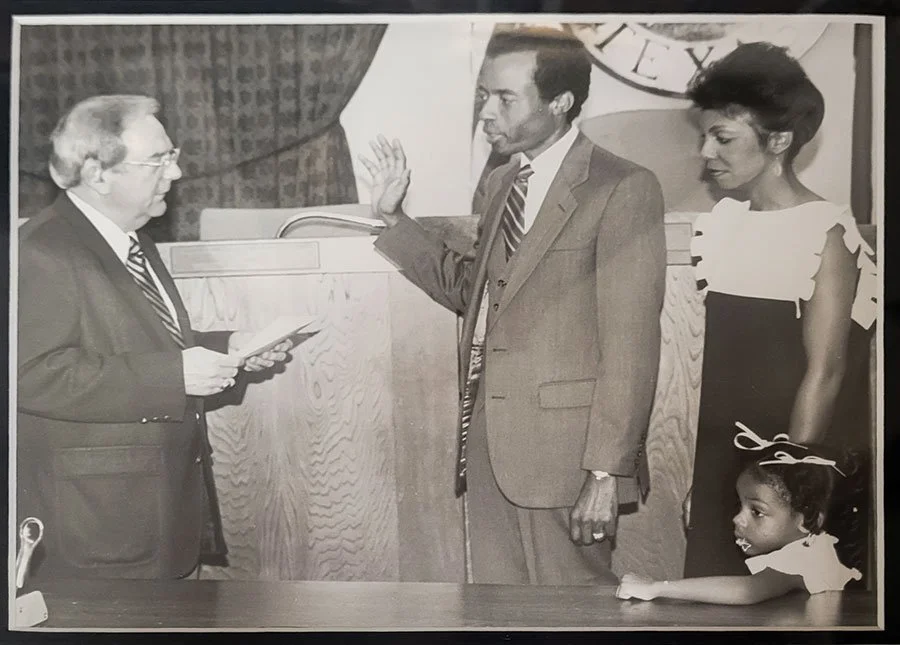
Mayor Durwood F. Swanger swore Dr. Denzer Burke into the Texarkana City Council in 1985. Denzer’s wife, Ann, and daughter, Dennel, joined him for the occasion. submitted photo
In light of his advocacy, Dr. Burke was asked to host a local television program called Circumspect. “I tried to encourage young people to become involved in the community,” he said with a smile. The show featured many local and national figures including Arkansas Governor David Pryor, Senator Dale Bumpers, and Congressman Max Sandlin. The program ran in the early 1970s on local television station KTAL-TV.
Around the same time, Dr. Burke got involved with democratic politics, working first at the grassroots level and eventually becoming a player on the national field. In support of Jimmy Carter’s presidential campaign, he and a local attorney opened a campaign office at the Grim Hotel and once spray-painted peanuts to create necklaces for fundraising events. After Carter’s election, Dr. Burke received an invitation to attend the presidential inauguration in Washington, D.C. Then, in 1980, he was invited to the White House as one of only two representatives from Texas for a national conference focused on inflation and the economy.
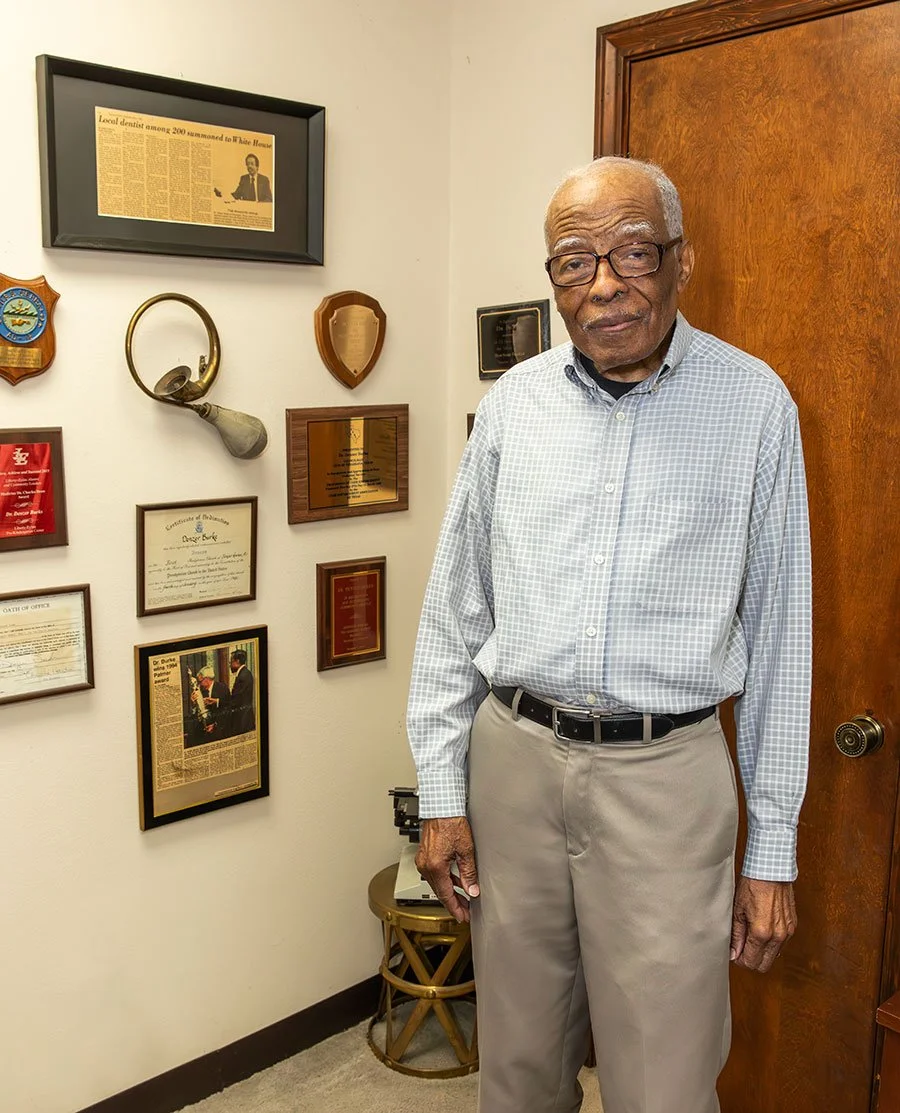
In his 93 years, Dr. Burke has earned numerous accolades for his dental and civic work. At the top of this wall is a newspaper article from 1994, when Dr. Denzer Burke received the prestigious C.E. Palmer Award from the Texarkana Chamber of Commerce in recognition of his extensive public service. photo by shane darby
His involvement in the Democratic Party gave Dr. Burke opportunities to meet several other nationally-known civic leaders over the years. “One of the people I met was Astronaut John Glenn during a Texarkana presidential-campaign stop,” he recalled. He also met Congressman John Lewis, civil rights leader Julian Bond, and President Bill Clinton.
Dr. Burke later became involved in efforts to change the city charter of Texarkana, Texas, so that council members would be elected to represent individual wards rather than being elected at-large. After the change passed, Dr. Burke was elected to represent Ward 2 on the city council, serving from 1985 to 1989.
In 1994, Dr. Burke received the prestigious C.E. Palmer Award from the Texarkana Chamber of Commerce for his extensive public service.
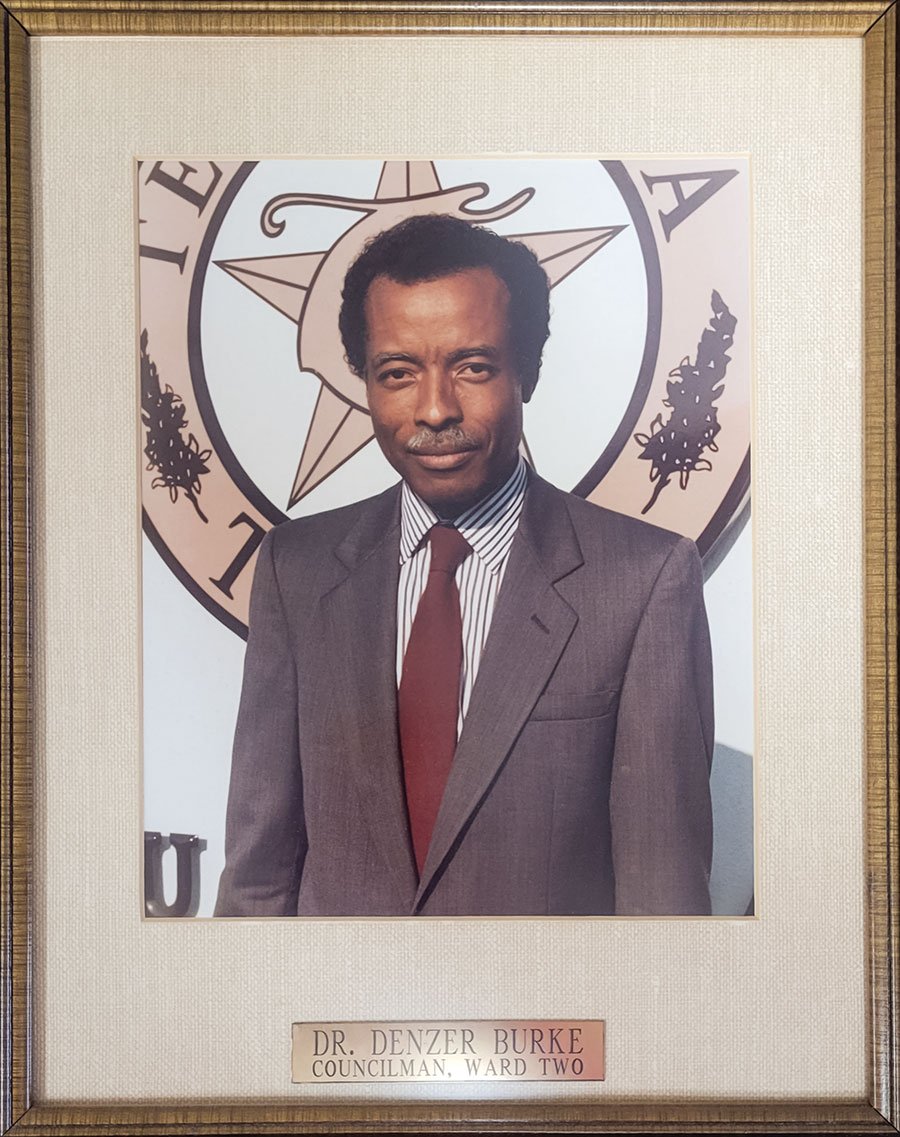
After successfully advocating for ward-specific representation on the city council, Dr. Burke served as the Ward 2 councilmember from 1985 to 1989. submitted photo
A Lasting Impact
At his core, Dr. Burke’s guiding principles are faith, service, and helping underserved communities. “I believe that, instead of worrying only about the hereafter, you have a responsibility to be Christ here on Earth,” he said. He has remained active and involved at First Presbyterian Church, serving in multiple leadership positions—as elder, deacon, trustee, and moderator for the regional presbytery.
When asked if he has had a legacy in mind throughout his career, Dr. Burke initially said no. However, after careful thought, he said, “I thought there was a need here. I wanted to help people develop a better outlook on life.” It seems he has done just that.