
In Tune with Change
/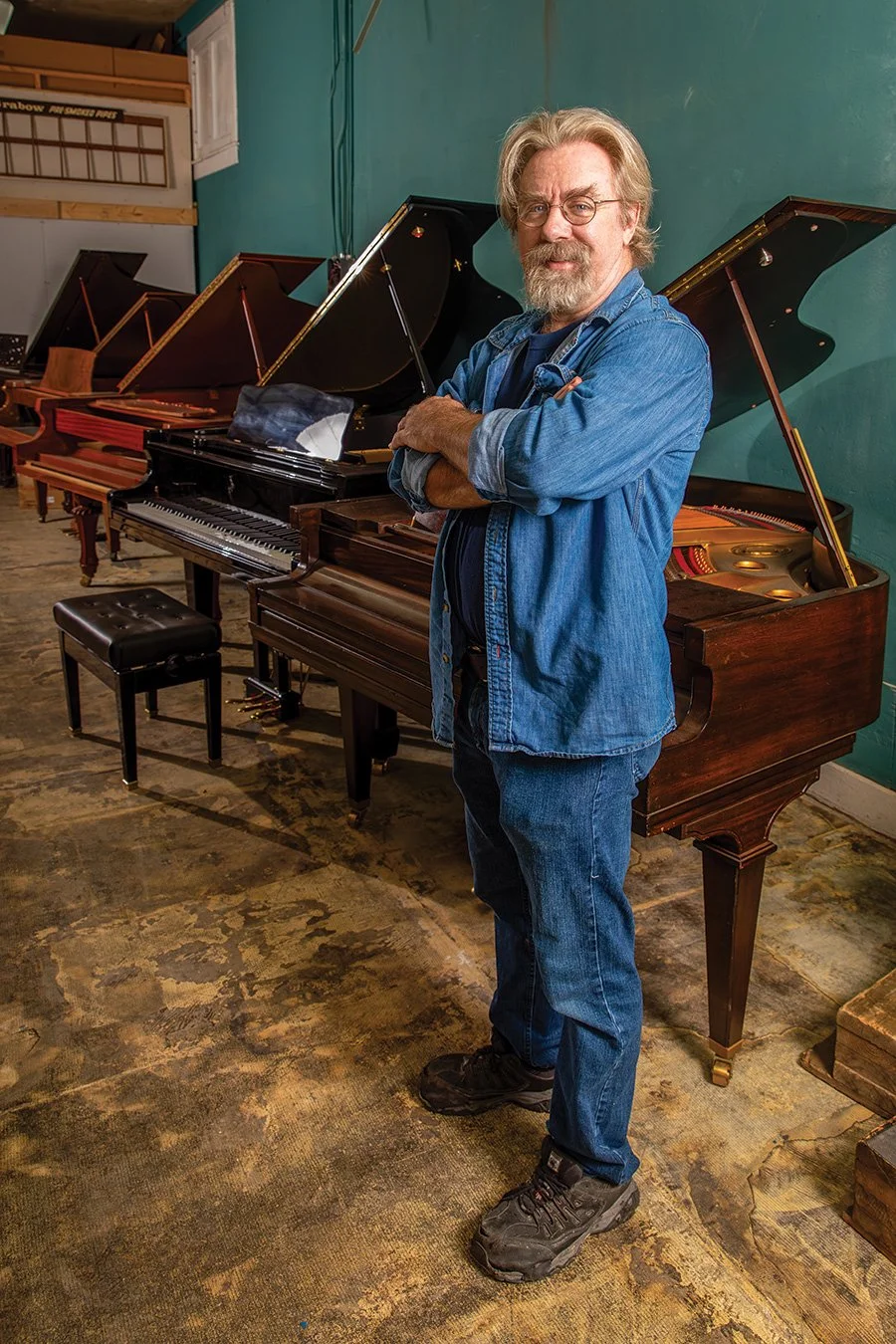
photo by shane darby
Howard Gustafson of Ragland Piano Company preserves antique instruments of the past with modern technology
By Jesse Warren
The building at 314 Main Street in Texarkana, Texas, has stood since 1913. In 1997, it became the home of Ragland Piano Company—a business that has evolved over its 30 years and maintains a strong sense of belonging within the downtown landscape.
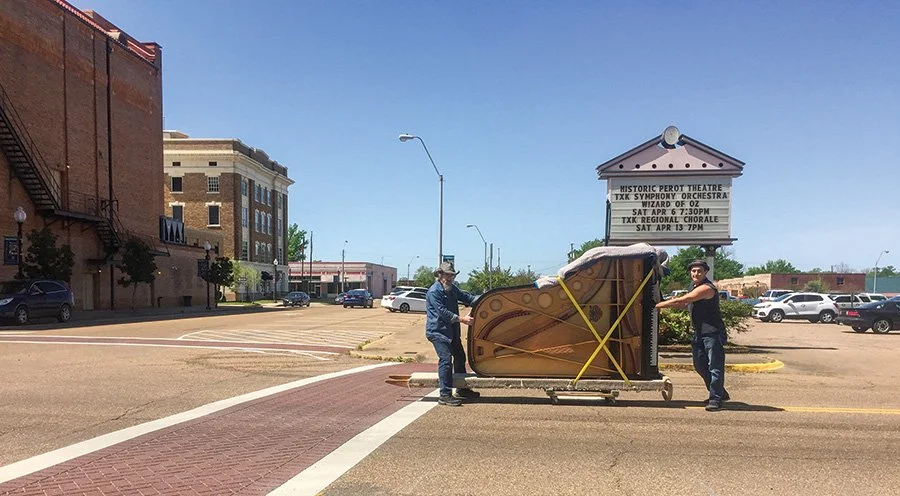
Howard and his longtime employee, Roy, delivered a piano to the Perot Theatre by rolling it down Main Street. submitted photo
In the days of the building’s construction, pianos were the pinnacle of home entertainment, and a thriving industry supported them. Much like radios or televisions in later eras, pianos were a staple in homes and communal spaces, and their size and quality were a symbol of status. While they haven’t retained that level of cultural importance, they have remained a musical hallmark worldwide and, for most of their existence, have been unrivaled by their digital counterparts. This was certainly the case when Ragland Piano Company opened its doors. However, instruments, like any technology, are subject to innovation, and no one has a better sense of this than the people who sell them.
“I see the industry going largely digital,” said Howard Gustafson, owner of Ragland. “There are always going to be folks who want to stick with acoustic pianos, and that’s great. I love acoustic pianos, but, as a businessman, if I were relying on acoustic pianos, I wouldn’t be here.”
It’s difficult to imagine such an iconic instrument entering its obsolescence, but the fact of the matter is that digital pianos have advanced quite a bit since their genesis and are chosen in lieu of their bulky ancestors with increasing regularity. When digital pianos sound just as good as—or better than—most acoustic pianos, why purchase the option that requires a small team to move and a technician to maintain?
“A nine-foot [grand piano] certainly is going to give any digital piano a run for its money, but you take any of these spinets and consoles—even studios and small grand pianos—and a digital is going to sound so much better,” Howard said. “The technology’s finally gotten there. Was that true in 1990? No, it wasn’t, but today it is.”
This outcome was inevitable, but, left in its wake is a world full of antique pianos with a dwindling pool of tuners, technicians, and parts suppliers to support them. When Ragland first opened, Texarkana boasted a healthy number of piano tuners, but most have since passed away or retired. These antiques aren’t small knick-knacks that can be easily stored away or placed on a shelf to admire. They’re feats of woodworking and engineering designed to be fixtures in the home. Many of these instruments now exist as unusable cherished family heirlooms, without an industry to support their usage. This is a problem Ragland aims to solve.
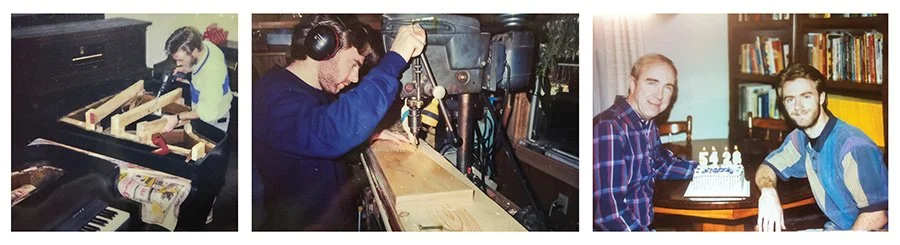
Left to right: 1. In the late 1980s, Howard made a piano shell for a night club in Memphis. He was asked to reinforce the top lid so it could be danced on. 2. On a family visit in the early 2000s, Howard assisted with piano repairs at his father’s shop, located in Oakland, Tennessee. 3. Howard learned how to repair pianos from his late father, Leonard. They shared a birthday, October 28th.
“We’ve carved out a little niche here, where we take these pianos and convert them to digitals,” Howard explained. “I don’t want to say I’m leading this charge or breaking new ground; people have been doing this. I did my first digital conversion in 1998.”
Howard compared piano conversions to vehicle restoration. “Look at all the old cars that people take, pull the old engines out of, the old interiors, and they put in new seats with seat belts and put in new modern drivetrain components. We’re just doing kind of that same repurposing to pianos.”
Most digital conversions Ragland takes on are custom jobs, tailored to the client’s requests. When the owner of an antique piano is facing costly restoration, Ragland offers a less-costly alternative, which preserves the piano’s look and feel and greatly reduces the potential for expensive servicing in the future. Their signature style of digital conversion emphasizes preservation of the look and tactile experience of playing the original piano. Projects that are given this treatment are branded “Digicoustic.”
“What we do with the Digicoustic is we give it a traditional piano action,” Howard explained. “It’s got keys, it’s got hammers, it’s got all the wooden parts you find in a traditional piano.” While there are no strings in a Digicoustic, the piano behaves as if there are, accounting for the velocity of keystrokes and creating a bigger sound the harder it is played. The digital systems that power them are designed by Howard himself, using non-proprietary electronic components that are readily available to consumers, a feature which puts the ability to replace parts into the hands of anyone with the skillset.
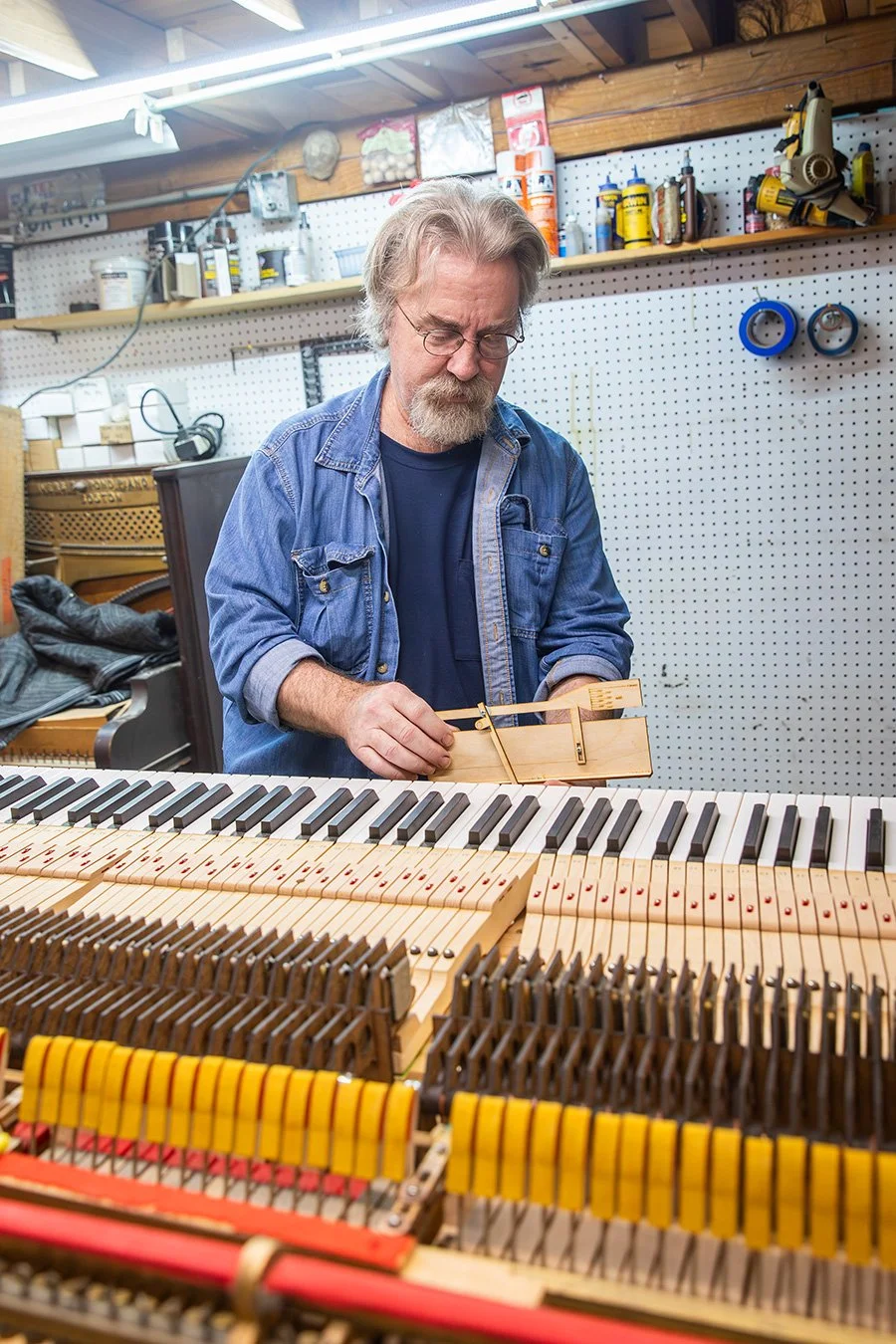
“My interest began when I saw a player piano for the first time, at a music store, and thought, ‘Well, that’s just the coolest thing I’ve ever seen in my life.’” – Howard gustafson, photo by shane darby
“Anybody familiar with pianos can work on the mechanical parts of a Digicoustic,” he said. “I’s kind of open source. Most of the speakers, the amplifiers, the wiring, all that stuff is readily available [for purchase] on the internet. We have not made any proprietary electronics where you have to come to us to get parts. It’s all right-to-repair stuff, which I’m real big on.”
Howard’s proclivity for technical work began in his childhood in Tennessee. Howard reported frequently taking things apart in his youth to see how they worked, ranging from small appliances to a 1946 Pontiac. As early as the age of 10, Howard assisted his father with work on the family piano.
“My interest began when I saw a player piano for the first time, at a music store, and thought, ‘Well, that’s just the coolest thing I’ve ever seen in my life,’” he recalled. “Then, I decided to start actually paying attention to what my dad was teaching me.” Pianos were ubiquitous in Howard’s community at the time. “I suppose if I’d been inundated with piccolos, I might have chosen to be a piccolo guy,” he joked, “but, no, I’m a piano guy.”
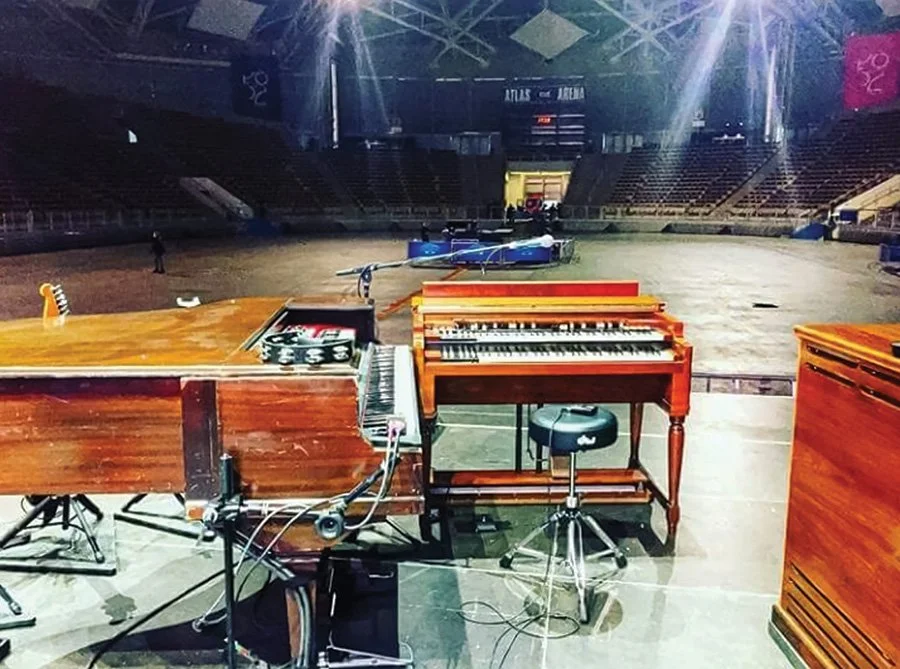
In 2016, Ragland customized this grand shell, which was used in Bryan Adams’ European “Get Up” Tour. submitted photo
Howard learned piano restoration alongside his father, Leonard, and worked with him in his shop throughout his teenage years. As a young adult, Howard worked at Amro Music Store in Memphis and grew his own business on the side, servicing and rebuilding player pianos. In 1995, a few years after opening his own shop, Howard made the decision to move his operation to Texarkana. He chose Texarkana specifically because of a relationship he was in at the time, but Howard also believes the move was necessary to allow his business to grow. In 1997, he purchased the building at 314 Main Street from The S.M. Ragland Cigar Company; Howard adopted the Ragland name for his business in honor of the Ragland family, who were “very, very patient with a struggling business man,” he said.
Ragland has evolved as a business throughout its life in Texarkana, but Howard has always maintained a focus on custom restorations and digital conversions, a service that wouldn’t be accessible to people in the area without him. This poises Howard to put his skills to work in a way he finds fulfilling. “I want to find things that aren’t being done well enough or being done at all, and I want to do a good job of doing it,” he said.