
Marfa Artist Profile: Kenisha Webster
/Last year, local artists Cindy Holmes and Kenisha Webster were selected to showcase work in the 2025 Marfa Invitational Open. The Marfa Invitational Open is a major exhibition showcasing top Texas talents. It features over 150 artists, including newcomers and established figures across various mediums. The event aims to discover new talent while honoring Texas’ most celebrated artists. One year later, Cindy and Kenisha reflect on their Marfa experiences, as well as their lives as artists more generally.
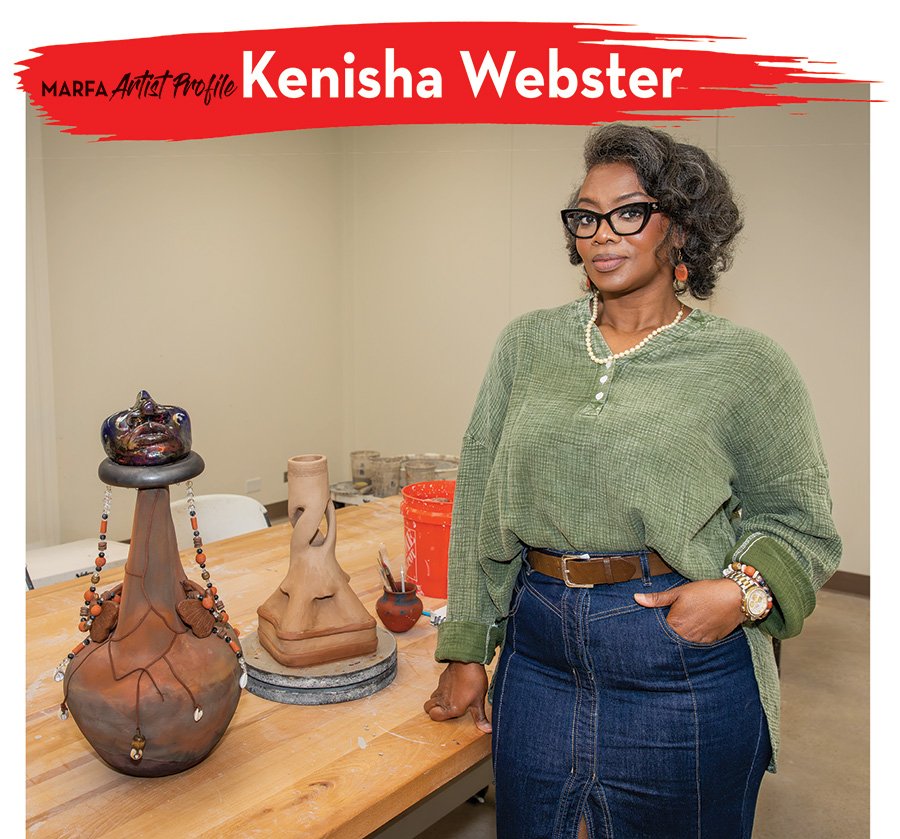
Tell us about yourself, your background, and your art.
I am a ceramic artist, photographer, painter, and mixed media artist. I originally attended college to study accounting; I never imagined that a ceramics class would completely change the direction of my life. The first day I touched clay, my whole world shifted. My work explores memory, land, labor, heritage, faith, and resilience. I often work with wild clay harvested from my family’s land, reclaimed materials, ashes, and natural pigments.
How was your experience with Marfa?
Being selected to show three vessels at the Marfa Invitational was one of the most exciting experiences of my life. The exhibition introduced me to an incredible community of artists and collectors from around the world. It was refreshing to be surrounded by people who understood the joys and struggles of the creative process without needing a translator. One of the exhibition curators, Sonia Bloom of Spain, became my gallery representative through Studio To Gallery in Miami, Florida. I am honored to be a charter member and grateful that my work is now reaching collectors around the world. I have since been invited to artist meetups in various countries. Marfa turned out to be much more than an exhibition. It became a doorway into a global community.
Where are you from, and how does that affect your work?
I am from Atlanta, Texas. The red dirt that became the base of my childhood “sweet potato” mud pies, the dirt that stains carpets and rugs, the earth that “ruins” concrete and freshly washed vehicles—it sits at the very foundation of my practice. The vessels I make do not begin in the studio or from a bag of clay ordered online. They began with a shovel—my daddy’s shovel—and with the clay dug from land my family owns. This clay is wild. It takes me about ten days to process it into what I believe is a workable consistency. I hand-process it slowly, listening with my fingers and waiting until it feels right.
I often wonder what my ancestors were thinking when they first acquired this land. For them, land was not just property. It stood for freedom, security, and something that could be passed down. I ask myself: how much blood and sweat does this earth hold? How many times did they want to give up but did not? What were their wildest dreams? And am I one of them? Sometimes I wonder if I am forming their legacy, or if their legacy is forming me. The answer is both.
Who is your favorite artist?
There are many artists who inspire me, but the person I will always recognize first is Dr. Angela Melde. She was the first person to challenge me to step outside of my comfort zone. She saw possibilities in me that I did not see in myself. She introduced me to watercolor and oil painting and later encouraged me to take ceramics. She pushed me, and because of that, I worked harder.
What is something you always have with you?
I always have at least one sketchbook and a pencil with me. Ideas do not care where you are or what time it is. I have learned that when inspiration speaks, I need to listen.
What is the biggest challenge of being an artist?
My hands cannot move as fast as my mind.
How is art important to society?
Art is an outlet. Art gives us a way to express what words sometimes cannot. Art helped me find healing, purpose, and confidence. It gave me a voice before I even knew what I wanted to say. As a person of faith, I believe that creativity is one of the ways we reflect the Creator. Art allows us to connect with one another, preserve stories, and sometimes heal places in ourselves that words cannot reach. Art creates conversations. It records history and reminds us of our shared humanity. Long after we are gone, art remains.
How do you define success as an artist?
Success is having the freedom to create what you want, the way you want, whether everyone understands it or not. Art is not always comfortable. People do not have to understand why I created something. They do not even have to like it. But if they stop, feel something, ask a question, or see themselves in the work, then I have done my job. And honestly, once the fire gets involved, good or bad, the project is complete. The kiln has a way of humbling you and reminding you that you are not in control of everything.
What’s something that people who know you would be surprised to learn?
Many people do not know that I paint with dirt, ashes, watercolor pigments, and oils. I enjoy allowing the materials themselves to help tell the story.