
Making Space for Art
/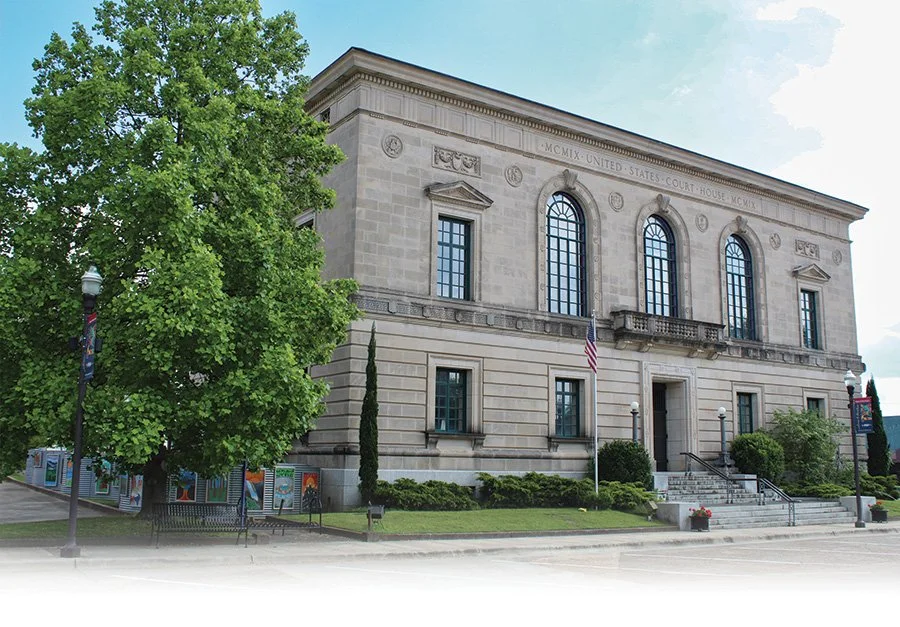
The Regional Arts Center is located in a former federal courthouse, built in 1911.
Established by the Junior League of Texarkana in the 1970s, the Texarkana Regional Arts & Humanities Council continues to grow its services
By Jaime Knighton
Nestled in an unassuming building at the corner of Pine and Sixth Streets in downtown Texarkana is one of the Texarkana Regional Arts & Humanities Council’s newest ventures: TRAHC’s ArtSpace at 518 Pine.
Step inside, and the building is anything but ordinary. Rooms are dedicated to creativity and hands-on opportunities to explore ceramics, visual arts, dance, and much more. There are spaces for workshops, private events, and creative gatherings—all designed to give people the opportunity not just to experience art but to create it.
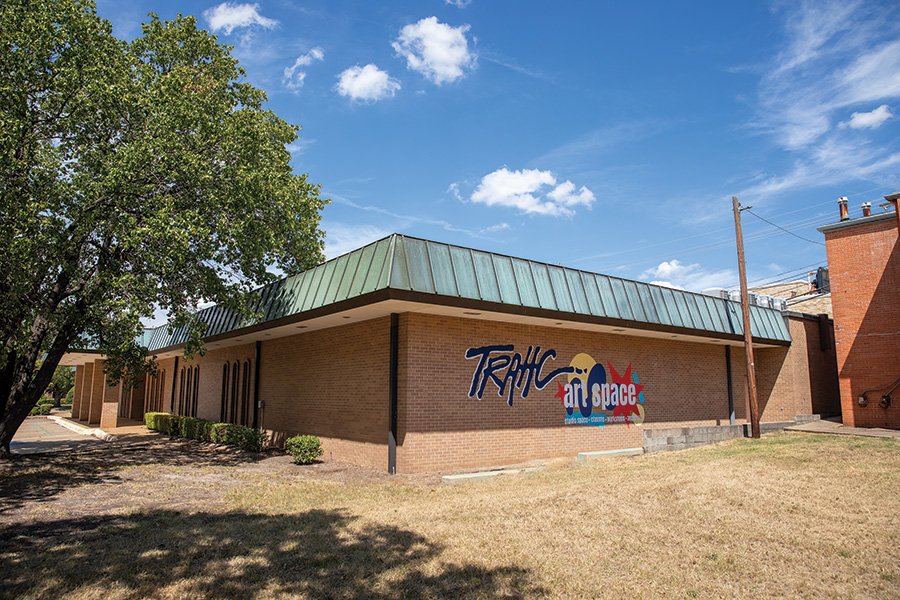
The TRAHC ArtSpace, located at 518 Pine Street, opened in 2025.
TRAHC’s ArtSpace didn’t simply appear as the latest home for its growing programs. There is nearly half a century of history behind what happens inside these walls—and that history began long before TRAHC had any facilities to call its own.
In the mid-1970s, the Junior League of Texarkana sent Judy Morgan and Tony Nixon to Beaumont, Texas, for a two-day seminar about arts councils. They returned convinced that Texarkana could support one. The Junior League committed $100,000—$50,000 a year for two years—to help get it started.
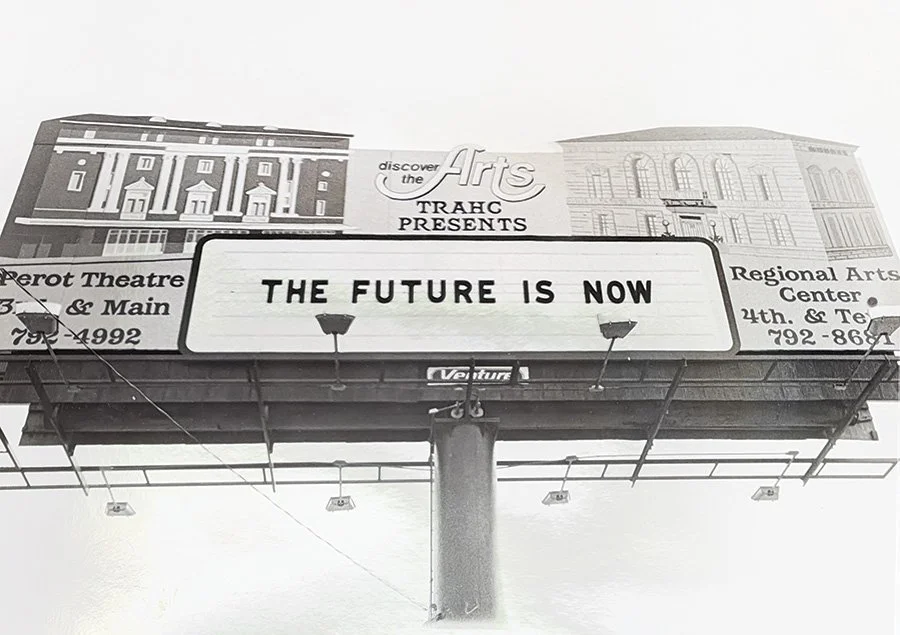
TRAHC advertises arts experiences at the Regional Arts Center and the Perot Theatre in April of 1989.
TRAHC began in what Judy remembers as a roughly 100-square-foot, city-provided office in a park near Texas Boulevard and College Drive. Its first major performance was the Dallas Ballet’s The Nutcracker at Texarkana College. She said that slow advance ticket sales caused plenty of worry, but those concerns were quickly alleviated when people came out in droves on a beautiful Sunday afternoon. From that tiny office and uncertain first performance, TRAHC would grow into an organization with a presence at the Perot Theatre and, later, the beautifully restored Regional Arts Center.
A few years later, the restored Perot Theatre gave TRAHC the community presence its founders had envisioned. After being granted stewardship of the Regional Arts Center, TRAHC gained management of the Perot Theatre, which gave it the ability to advance the community’s artistic activity. Standing onstage when Ross Perot brought the Dallas Symphony Orchestra for the theatre’s opening, Judy remembered thinking, “My gosh, we have made this. We have done it. We’re here.” For decades, TRAHC’s management of the Perot Theatre allowed the organization to bring performances to Texarkana that residents once had to travel elsewhere to experience, helping make the arts a more visible part of community life.

Students on a field trip line up outside the Perot Theatre in anticipation of a performance.
That was really only the beginning.
After an extensive restoration, the historic former federal courthouse became the Regional Arts Center, giving TRAHC the kind of permanent home Judy and Tony had first heard was so important at that seminar in Beaumont. For Judy, the transformation—from that tiny office in a park to a restored courthouse filled with exhibits, performances, and community events—remains one of the accomplishments she is proudest of.
That growth was fueled not only by new spaces but also by people willing to raise money, volunteer, and build programs. Women for the Arts became an important part of that effort, organizing fundraisers and supporting TRAHC’s work as the organization expanded. Judy remembers those early efforts as operating on a “shoestring” budget. For one early fundraiser at the Elks Lodge, volunteers even brought in refrigerators and ovens because the venue had no kitchen.
TRAHC’s reach extended beyond performances and exhibits and into area schools. Programs designed to introduce children to theater, visual art, and other creative experiences became an important part of the organization’s work, particularly for students who might not otherwise have had those opportunities. Judy said that seeing children experience the arts for the first time was one of the things that has made the work worthwhile.
The impact of those programs can be seen across generations. Former TRAHC President Phyllis Deese, also a former school principal, remembers watching children enter the Perot Theatre and experience a performance for the first time.
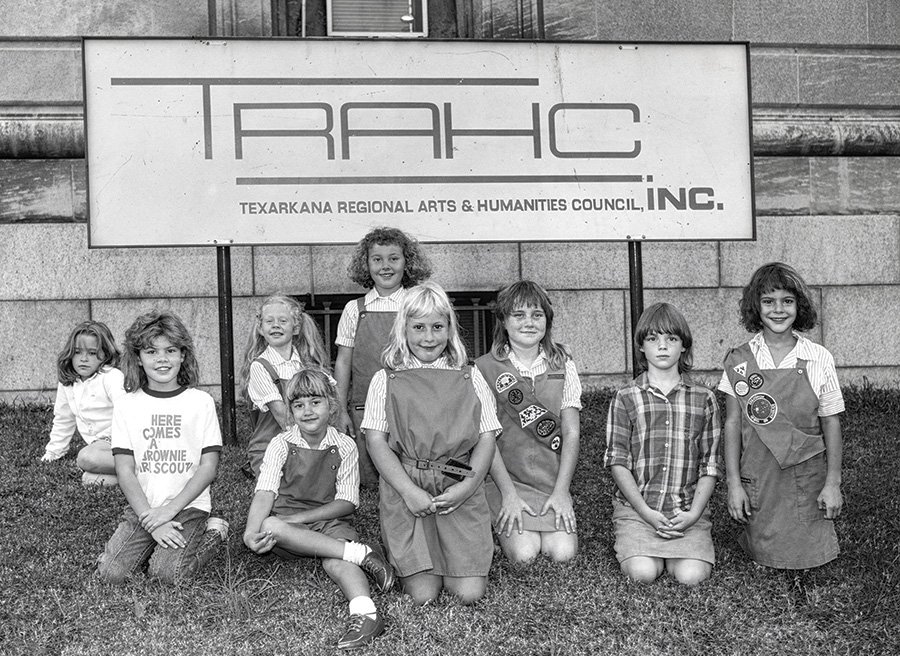
A local Girl Scout troop visits the Regional Arts Center is pursuit of arts merit badges.
Decades later, TRAHC Marketing Coordinator Sara Vaughn represents the other side of that story: she grew up attending TRAHC programs herself and now helps provide those experiences for another generation. Sara said that those childhood experiences shaped her own perspective, and today, as she watches students walk into Theatre for Young Audiences performances, she knows that many are experiencing live theater for the first time. She sees that impact in a different way at TRAHC’s ArtSpace when students return to pick up pieces they have made in ceramics classes. Their excitement over being able to say, “I made this with my own hands,” she said, captures the kind of experience she wants everyone to have.
Community support has continued through each generation.
“Organizations like TRAHC don’t just happen by accident,” Phyllis said. Volunteers, donors, sponsors, board members, and staff have all played roles in keeping it moving forward.
Current president Louise Tausch has seen that growth bring both opportunity and new challenges. When she became president, Louise made increasing corporate sponsorships a priority, believing that greater business involvement could lead to greater community and family engagement. At the same time, TRAHC was entering unfamiliar territory.
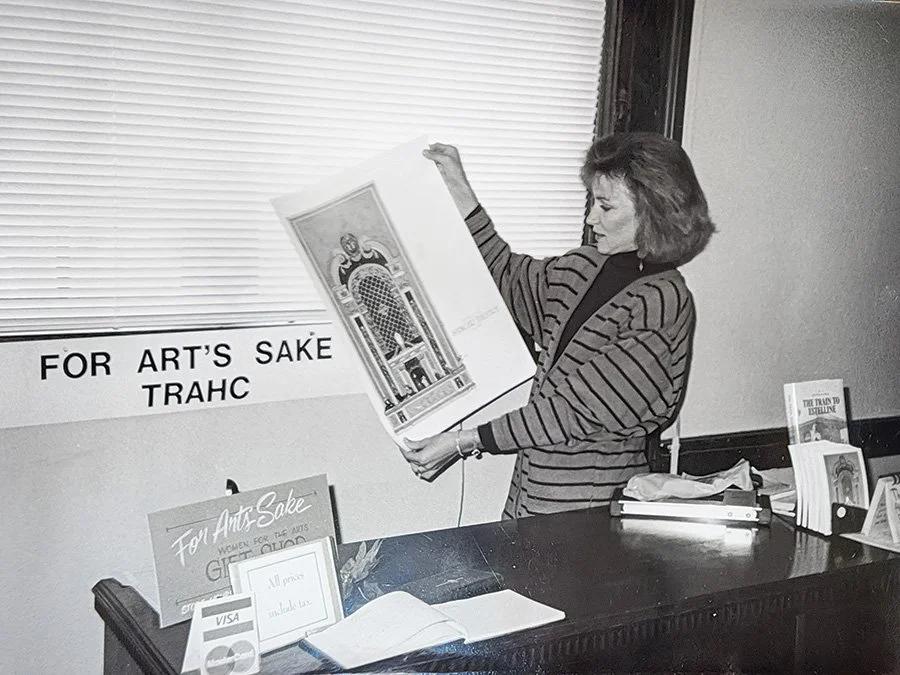
In the late 1980s, an artist holds a contest-winning poster, created by Jane Plalz, in the For Arts’ Sake Gift Shop. The print was sold at the Perot Theatre for many years and is still available for purchase at the Regional Arts Center.
“This is the first time I am aware of that TRAHC has supported and managed two beautiful, large buildings, with ample room to fulfill so many of our needs,” she said. “While it is a dream come true, the beginnings have been a little bit of a challenge.”
Louise credited community supporters, TRAHC’s staff and board, and the incoming president, Gary Gathright, whom she said was at TRAHC’s ArtSpace “day after day during the remodeling,” with helping turn ArtSpace into what it is today. According to her, that kind of community involvement is also the answer as to how TRAHC has survived for nearly 50 years. From Women for the Arts and longtime sponsors to the couple taking a ballroom dance class or the stressed businessperson trying clay for the first time, they all are working toward the same purpose—encouraging people to experience art and creativity in their lives.
As Interim Executive Director Marcus Zwiebel explained, the two buildings now serve complementary purposes. The addition of ArtSpace doubled TRAHC’s square footage, but its purpose goes beyond simply having more room. “We maintain the Regional Arts Center to experience art, and our second location is maintained to be the space where folks actually create art,” he said, adding that the two buildings have allowed TRAHC to expand its impact while remaining true to its mission.
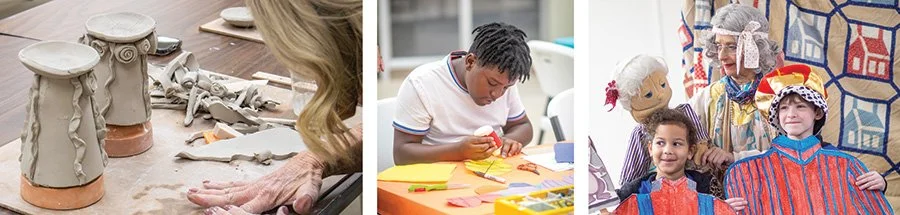
The ArtSpace is a creative facility featuring the Mayo Arts MakerSpace, as well as ceramics and visual arts studios. They offer hands-on classes and workshops for artists of all ages.
As Gary prepares to lead TRAHC toward its 50th anniversary, he is looking at what comes next while protecting what has carried the organization this far. Long before joining TRAHC’s board, he experienced the organization from the community side, taking his daughter to events such as Jump, Jive, & JamFest and even helping build TRAHC art installations as a young engineer. Now, as he prepares to serve as president from 2026 to 2028, he wants to continue developing ArtSpace into what he calls a “self-sustaining entity,” with opportunities ranging from performances and creative nights out to technology-based activities such as robotics and electronics. “Who better to be creative than an arts organization?” he said.
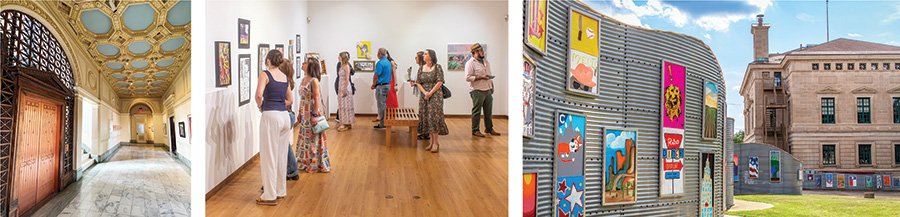
The Regional Arts Center is the home of TRAHC’s public art gallery. Additionally, it contains the For Arts’ Sake Gift Shop and Cabe Hall, an event space.
The buildings have changed. The programs have grown. Generations of leaders have come and gone. But the idea that Judy and Tony brought home from Beaumont remains: giving people opportunities to experience creativity, connect with one another, and grow through the arts. As TRAHC approaches its next half-century, the incoming president hopes to continue expanding those opportunities while building community involvement and the support needed to sustain them.
Gary’s goal for what comes next is simple: “We want Texarkana to be proud of us,” he said.